For New Readers
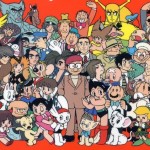
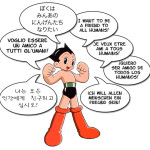
Above: Commemorative postage stamps show Tezuka's most beloved characters, incuding Tezuka himself, who often appeared in his own work.
- Another recommended starting point for newcomers is Ada Palmer's essay "Film is Alive: the Manga Roots of Osamu Tezuka's Anime Obsession", sponsored by the Smithsonian Freer and Sackler galleries.
SECTIONS OF THIS PAGE:
- Who is Osamu Tezuka?
- What are the Major Characteristics of Tezuka's Works?
- What are Tezuka's Major Works?
- What should I read or watch first?
- Where do I go next?
WHO IS OSAMU TEZUKA?
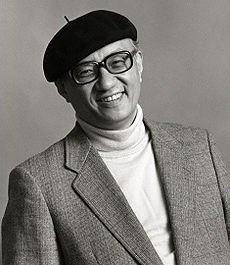
Osamu Tezuka (1928-1989) was a manga author, that is a Japanese comic-book author, and creator of many of the first Japanese animation. Because manga are far more influential and respected in Japan than comics are here in America, Tezuka’s works had tremendous impact on Japanese culture, literature and film, especially during the post-war period. His work focused on the themes of the progress, technology, environmentalism, tolerance, and reincarnation, and his messages of hope and calls for greater social responsibility have made him one of the most respected cultural figures of 20th century Japan. In America, Tezuka’s best known creation is the world-renowned children’s series Astro Boy, but in his lifetime he drew more than 150,000 pages of manga, touching on every style and genre, writing for every age-group from young children to mature audiences, and single-handedly creating the majority of the genres and character-types we see in manga and anime today.
WHAT ARE THE MAJOR CHARACTERISTICS OF TEZUKA’S WORK?
The first thing most readers notice about Tezuka’s work is its childish, cartoon-like art style. Osamu Tezuka was inspired in his style by the early Disney films. A common "legend" about Tezuka claims that he watched the movie Bambi over eighty times. In practice, however, these simplified character designs allow Tezuka to communicate an astonishing range of expression and emotion, enhance, rather than limiting, his ability to depict an enormous range of moods and subjects, from the giddy, childlike thrill of a child's first trip to space to the intense brutality of the Second World War.
Tezuka wrote more than 700 series over the course of his career, but there are distinct themes for which he is best known:
- Prejudice and intolerance, and whether it is possible for two races to coexist in peace.
- War, its psychological causes and effects on individuals and societies.
- Transformation and the appeal of unleashing bestial and evil portions of the psyche.
- Environmentalism and the balance between man and nature.
- Science and Medicine, their purposes and limitations.
- Reincarnation and the cycles of life and death and the rise and fall of civilizations.
- Buddhism and where it succeeds and fails to satisfy the human need for spiritual guidance.
Many of Tezuka’s works are science-fiction portraits of the future, some utopian others distopian or even apocalyptic, focusing on technological utopian cities, space exploration and especially robots. Astro Boy is only the most famous of many works in which Tezuka uses the relationship between humans and robots to explore questions of human rights, tolerance and prejudice, themes he also explores in his real-world stories, especially his treatments of the second world war and its aftermath. Tezuka stories also frequently treat animal rights issues, capitalist and political corruption and medical ethics. As a young man, Tezuka trained to be a doctor, and his detailed portrayals of the medical world in Black Jack and other stories show insider knowledge both of medicine and of medical politics, and have made him one of the all-time great masters of medical techno-babble. Perhaps the most unifying theme in Tezuka's work is reincarnation, treating karma, the quest for immortality and the justice or injustice of the reincarnation cycle. This is the subject of Tezuka’s life-long master project Phoenix. The Message section of the official Tezuka World site has illustrated essays on sixteen themes which they consider to be the central message of Tezuka’s work, including Future, Love, Friendship, Life, Freedom, Science, Nature, War, Discrimination, Courage, Parents & Children, Animals, Religion, Dreams, Destruction and Medicine.
Perhaps the most distinctive element of Tezuka’s work is his “Cast” of recurring characters. You will see the same faces over and over in various works, children’s and adult, and the "career" of each character can be traced through the course of Tezuka’s lifetime. Tezuka viewed his characters as "actors," who might appear in similar roles in different works, to evoke connections in the minds of his readers. This "Star System" is not simple re-use of character design, but the long-term exploration of a single character in multiple forms, and often the events of one story will explain a character’s fortune and position in the next. In Phoenix Tezuka deals directly with the question of reincarnation, tracing the lives of characters as they are born again and again from the dawn of civilization to the far distant future, and showing how the events and actions of each life determines the next, so the more Tezuka’s works you read, the richer each story of each character becomes. This "cast" system ties the whole corpus of Tezuka together in a way truly unique among authors the world over.
For more information on Tezuka’s “cast”, follow the link to "star system", or visit our Tezuka Characters Page, featuring an index of recurring characters.

WHAT ARE TEZUKA'S MAJOR WORKS?
Find in-print English releases easily through our Amazon.com Tezuka List.
As Osamu Tezuka created and published over 700 titles in his lifetime, it is difficult to select only a few, however, the official Tezuka World website has highlighted twenty-one works for inclusion in a "Major Works Gallery". The gallery is extensive, so we have compiled here some brief information about why some of them are important.
- New Treasure Island was the first manga to involve cinematic techniques in its layout. It was also Tezuka's first big hit, and his first graphic novel publication.
- Lost World, Next World, and Metropolis comprise Tezuka's "science fiction trilogy." All three were formative stories in Tezuka's career, and in the science fiction boom in Japan.
- Kimba the White Lion, also called Jungle Emperor Leo, was an Tezuka's first full-scale serial manga, and remains one of his best-loved creations. It treats environmentalism, symbiosis with nature, and racial intolerance.
- Princess Knight is the first modern shoujo manga (manga aimed at female readers). It draws heavily on early Disney fairytale stories, and Japanese all women's musical theater. It particularly explores gender roles as the hermaphroditic protagonist oscillates between male and female personas.
- In Adventures of Rock, Rock Holmes, one of Tezuka's most important "actors," stars in a dark series portraying the breakdown of relationships between humans and other species.
Astro Boy, originally titled Tetsuwan Atom, is easily Tezuka's best known work, using the tension between humans and robots to explore racial tensions and prejudice on a level children can understand. It was made into the first Japanese animated TV series. - Phoenix is considered "Tezuka's lifework," because he worked on it throughout his career. The different volumes alternate taking place in the distant past and far future, watching the rise and fall of human civilization and of reincarnated individuals as watched over by the universal avatar of life, the Phoenix. Tezuka died before completing this series.
- Dororo is Tezuka's classic samurai manga, set in the civil war period of Japan, and was influential in forming the popular genre of samurai comics.
- Marvelous Melmo is a story about a little girl who can magically transform into an adult. It was intended to excite young people about the possibilities of different adult career paths, and to serve as a sex-ed story for young girls.
- The title character of Black Jack is a representation of Tezuka's ideal doctor, who expresses Tezuka's ideals of the medical profession, as well as his problems with the field. In Japan, Black Jack is regularly voted the second most popular character in all of anime and manga (after Char from Mobile Suit Gundam).
- Buddha is a biography of Buddha, in which Tezuka cast some of his original characters as key historical figures. This series has met with great critical acclaim in Japan, China, America, France, Italy and India.
- Unico is a sweet fantasy for small children, about a unicorn who can grant wishes as long as someone loves him, exploring the power of love.
- The Three-Eyed One is a "sci-fi ancient archeological mystery." The title character, Housuke Sharaku, is normally a weak and picked-on young boy, but when his third eye is uncovered he becomes an evil genius, the last ancient and powerful race of Three-Eyed Ones bent on recovering his ancient birthright and conquering humanity.
- Stories of Adolf is Tezuka's historical manga about three men named Adolf, of whom one is, of course, Adolf Hitler. In it he explores the psychological effects of the war on those growing up in Japan and Europe.

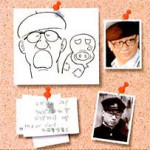
Above: Tezuka as he depicted himself in many different works.
WHAT SHOULD I READ AND WATCH FIRST?
You need to be careful choosing your first Tezuka, because his earlier works can be rough and confusing, and many readers accustomed to the beautiful art popular in current manga are put off by his cartoony, childish style. We recommend starting with his more mature works and getting used to his style before you try earlier works works. For English language readers, the best place to start is probably Apollo's Song (1 thick volume), a microcosm of Tezuka's larger universe, which explores human attraction, sexuality, reproduction and reincarnation with a mixture of real world, historical and sci-fi settings, displaying a lot of Tezuka's signatures. Another great first taste of Tezuka is his serial medical drama Black Jack (17 vols), about a mysterious genius unlicensed surgeon, by far the most popular Tezuka title for adults and a great entry point.
Also fine for starting are the now out of print WWI commentary Adolf (5 volumes), the easier to find Buddha (8 volumes), a biography of the Buddha outlining Tezuka's particular comments on Buddhist philosophy, Ode to Kirihito (1 thick volume), which explores medicine and bestial transformation, MW a dark commentary on WWII, Catholicism and homosexuality, and Swallowing the Earth, a crime-thriller about a plot to take revenge on men for the evils women have suffered throughout history.
Another good starting point is Astro Boy, the original super-robot who is Tezuka's most famous creation. Astro's comic book adventures, while aimed at children, treat many mature social issues, particularly social prejudice and environmentalism, and I know many readers who thought they were too disillusioned to ever like a hero character again, but for once found themselves rooting for the good guy. Again, the Astro Boy manga is better, and darker, than the various animated versions. Readers who understand French or Italian also have access to other mature social commentary works including Ayako, Rainbow Parakeet, Vampires, and the French edition of Prince Norman, a prime example of the innovative science-fiction stories which became Tezuka's signature.
Other works available English (though often hard to find) include Phoenix, Princess Knight, Nextworld, Lost World the Kimba the White Lion (Jungle Emperor Leo) anime, the Metropolis movie and the Metropolis manga. I recommend waiting on these until you are used to Tezuka's style. The Metropolis movie can be a good starting place, if you keep in mind the fact that it is a hybrid of a number of other stories, and that if many of its plot points seem unoriginal, that is because the original stories are old and influential, and have been imitated many times. Phoenix, Tezuka's master treatment of reincarnation, is complexly interconnected to the rest of his writings as recurring characters appear in multiple reincarnations both in Phoenix and in other stories. For this reason, Phoenix becomes better the more other Tezuka you have read first, so I never recommend it as a starting place. Remember, much of the richness of Tezuka's work comes from the re-use of characters, so the first few works you read will not be as rich as later ones, no matter what order you read them in, since you wont know the characters yet. After you have read four or five of his works, if you go back read the first one again, no matter which one it was, it will have an entirely new meaning.
Short version: Start with Apollo's Song, then Black Jack, Buddha, MW, Swallowing the Earth or Ode to Kirihito and, if you can find them, the out-of-print volumes of Adolf. Move on to the samurai adventure Dororo or the Astro Boy manga. After these, you are ready to tackle Phoenix and the Metropolis movie, or move on to the Astro Boy TV series, Black Jack anime and the old science fiction works.
WHERE DO I GO NEXT?
Now that you know the basics, find out more by visiting other sections of our site accessible through the tabs above, or for outside sources, try:
- Freer & Sackler Tezuka Film Retrospective website featuring:
- An excerpt from Fred Schodt's The Astro Boy Essays
- An excerpt from Natsu Onoda Power's God of Comics
- An excerpt from Helen McCarthy's The Art of Osamu Tezuka
- An original essay by Ada Palmer, "Film is Alive: the Manga Roots of Osamu Tezuka's Anime Obsession", a good source for newcomers to Tezuka's work
- The Wikipedia Online Encyclopedia article on Osamu Tezuka
- TezukaOsamu.net, the official Japanese Tezuka web page (Japanese only)
- Osamushi.it (Italian Language only)
Trouble navigating TezukaInEnglish.com? Try our Site Map