Adventures of Rock

(No Western editions.)
- Tezuka World Adventures of Rock page
- Tezuka World Rock profile
- See also our Rock profile under Character Profiles and our analytical essay, Rock Holmes: Transformation.
After his key roles in Detective Boy Rock Holmes, and Nextworld (1951), Rock served as the protagonist of a number of children's adventure stories, of which the most influential by far was Adventures of Rock (Rock Monogatari) (1952-54). This is another of Tezuka’s explorations of consequences of the meeting of two different sentient species, comparable to Zero Men, (1959-60) Captain Ken (1960-61) and Astro Boy (first manga series 1952-68). In this case, the clash involves not two races but three, as humans discover a planet in our own solar system, sharing Earth’s orbit but on the other side, inhabited by two races, the Epooms, bird-men, and the Lubrooms, clay-men. The Epooms and Lubrooms have already settled their conflict with the complete enslavement of the Lubrooms, and as the humans and Epooms come into conflict everyone wonders whether their relationship can be peaceful, or whether it will also result in the domination or extermination of one of the two races. The situation is rendered more complicated by the fact that the Epooms are at a very primitive technological level at the point of first contact, but access to fire and other human technologies result in their rapid and revolutionary progression to very advanced technological levels, a change none of the three races are prepared for.
ROCK'S ROLE:
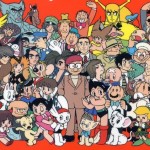
The version of Rock in this story is the very childlike version second from the right in the strip above. The young Rock, as the leader of the first expedition to explore the new planet, is the first to contact both these species, and serves as a bridge and ambassador between them and humans. Due to the mutilation suffered by the Nextworld manuscript which resulted in the omission of much of Rock’s character progression, Adventures of Rock is the clearest surviving example of pre-Vampire Rock's unique place in the Tezuka universe as the boy who is not a hero. Unlike Kenichi, Astro, Shinichi and others, Rock is not an eternally innocent, noble and optimistic, but is transformed over time by his experiences of violence, crime, war, and above all by witnessing the successes of evil. Over the course of the story, he becomes willing to acknowledge the fact that the Good solution to a problem is not always the best, and that sometimes violent or evil methods will result in better consequences long-term. But this is still the boy Rock, not yet the villain of Vampires (1966-69) or Alabaster, (1970-71) so his goals remain altruistic like those of Tezuka’s other boy heros, and he ultimately fights for peace more often than for power.
Here follows a complete story synopsis, excerpted from the catalogue of the 1990 museum exhibition of Tezuka’s works (unfortunately the catalogue has no ISBN number or publisher). This synopsis reveals the entire story from beginning to end, though omitting subplots, so should not be read by anyone who does not want to have the ending given away. The English translation of the summary provided in the book is not always of good quality, but it is comprehensible, and still the best English language source on the subject. For an analysis of the ending of the series, see the analytical paragraph at the end of the Zero Men series page. For more on Rock, see his character profile, and the Vampires and Fumoon series pages. A longer analytical essay on Rock is coming soon.

ADVENTURES OF ROCK (ROCK MONOGATARI): This work was serialized in "Shonen Club" along with Astro Boy (cat. no. 7). Because it has a complicated and fantastic plot involving a struggle between the humans and the bird people of another planet, "The serialization ended without most of the children of the time understanding the story" (from the postscript in the Collected Works, MT8). In fact, The Adventures of Rock has a too serious content for a manga for children. It is based on an idea taken from War with the Newts (1936) by the Czechoslovakian novelist Karel Capek (1890-1938).
As with Astro Boy Plays the Role of Ambas¬sador, the story begins with an unknown planet that is oddly similar to the earth appearing sud¬denly. The star, named Dimon ("demon"?) after its discoverer, was "a planet at the opposite position from the earth revolving around the sun at the same velocity and on the same course as the earth," but after coming close to the earth and causing a catastrophe on it, it becomes the earth's second moon. As is usual in this kind of story, an exploration party is organized. It is headed by Rock, the son of the late Dr. Dimon and the in¬heritor of the rights to the planet.
When the party lands on Dimon, they find that the planet has an atmosphere like the earth's but is inhabited by intelligent forms of life totally dif¬ferent from humans. First, there are clay people who can change shape at will. They are called Luborooms, and in an instant several of them copy Rock (This reminds us of the film by Andrei Tartovzki, Solaris, but there seems to be no direct relationship.) And surprisingly, there are also bird people called Epooms who treat clay people like slaves and lead a life comparable to that of the earth’s Middle Ages. The main concern here is again the “ningen-modoki” (humanoids) who are human and nonhuman at the same time, which appear in so many of Tezuka’s works, and the theme of the whole work is the struggle with this other self. So it is not mistaken to consider this work as one “which treats a confrontation and reconciliation with an alien culture” (Eo Takatori, extra number of “asahi Journal”, P. 42). But this “alien culture” is really our other culture that lies within us and not beyond the horizon.

The struggle between the bird people and the human is triggered when Rock, who has come to play the role of the father for Chiko, a child of the bird people, by chance, teaches them how to use fire. In the Greek myth, Prometheus who has given fire to the humans is chained to Caucasus Mountain and punished until the time's end. Rock too ultimately comes to be torn between his loyalities for the bird people and the humans, and dies a tragic death. We cannot know to what extent Tezuka himself intended the similarity, but it is undoubtedly there, in a strange form.
The use of fire is the basis for modern technology. Thus the bird people become civilized quickly, and learn to build weapons. That civilization equals weapons is an obsession of Tezuka’s, which seems to have haunted him persistently. And in a short while, the humans find out that the seas on Dimon are those of crude oil, and they send the second exploration party. This is the start of the invasion of the humans, who have more potent weapons, on Dimon, and the bird people are sent back in great numbers to the earth as slaves. The slaves are not only worked but also sold to be slaughtered for meat. The artist’s imagination is almost demonic in coming up wit! these ideas.
There is one scene that is particularly symbolic: When a need for blood transfusion arises in a rocket, there is no human of the same blood type on board, so they experiment with a birdman’s blood and are successful-only the birdman dies. It means that humans and the bird people cannot coexist.

Being fed up with the tyranny of the humans, the bird people, led by Chiko, the disciple of Rock, start a bacterial warfare using a strain of epidemic disease on Dimon, and become overwhelmingly victorious, ultimately demanding two continenents on earth. Rock, who wants to reconcile the two races, is exposed to a concentrated fire from the birdmen when he fights against villains who try to kill Chiko, and dies, as I have said, incinerate by the fire. (The scene of Rock's death was added when the story was published in book form.) Rock's last words are very suggestive: "Chiko, please listen to my request. Neither of the two races should have gone to the other's planet… Return to Dimon…Taking your people with you…” But Dimon is nothing else than another earth, and the problem cannot be resolved by everyone returning home. Though the story ends with a ritual to commemorate Rock, Tezuka probably said "I wanted to continue the story longer because he was aware of the interminable struggle with the inner "other" that was taking place inside himself. Despite the fact that this manga is for children in form, it is a masterpiece with a strong ideological concept. (K.M./K.K.)